
Firefighter Tactical Fitness: CRACKYL Workout 24-1 AMRAP
By Ryan Provencher, Founder of Firefighter Peak Performance and Executive Fitness Advisor for CRACKYL Magazine
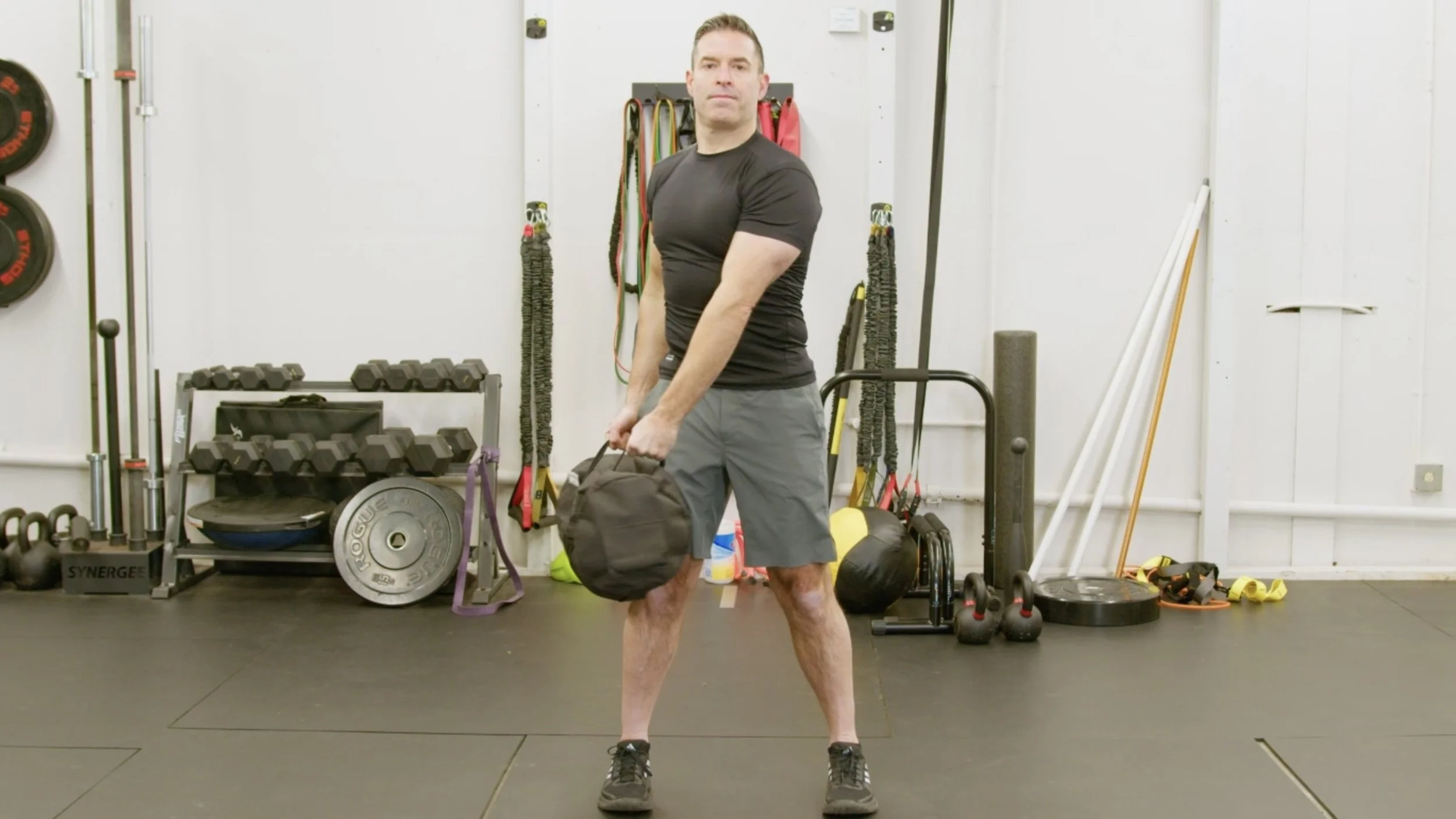
Build strength, power, and work capacity with this 20-minute AMRAP firefighter workout that carries over to the fireground.
Firefighter fitness does not require complex equipment or elaborate facilities. It requires intentional training grounded in sound movement patterns, appropriate workload, and energy system demands that reflect the realities of the job.
The Firefighter Tactical Fitness Series is a collaboration between Firefighter Peak Performance and CRACKYL Magazine, highlighting practical, field-tested training protocols and simple tools that support firefighter readiness.
At its core, this series is about helping firefighters train with purpose. Not just to work hard, but to train in a way that carries over to the fireground.
This workout centers on two of the most effective and versatile loading strategies available: sandbags and kettlebells.
These tools create an unbalanced load, demand full-body control, and reinforce coordination, stability, and force transfer under fatigue.
Combined with the AMRAP training protocol, they challenge your ability to sustain effort, manage pace, and maintain movement quality across extended work periods.
TOOLS: SANDBAGS AND KETTLEBELLS
The primary tools featured in this workout are sandbags and kettlebells.
Sandbags and kettlebells provide simple, effective loading options that challenge strength, stability, and control through dynamic resistance. They are compact, versatile, and well-suited for any station-based training.
From a training standpoint, these tools emphasize trunk stability, grip strength, unilateral loading, and coordinated force production—qualities essential for firefighter performance and durability.
Sandbag and kettlebell training can scale across individual sessions, crew-based station workouts, and recruit academies within a structured fitness program.
For departments and individuals seeking effective training without relying on complex equipment, these tools remain highly practical and accessible.
TRAINING PROTOCOL: 20-MINUTE AMRAP
This workout uses a 20-minute AMRAP training protocol.
AMRAP stands for “As Many Rounds As Possible.” Firefighters move continuously through the prescribed exercises, completing each sequence to finish one round and repeating that cycle for 20 minutes.
This format reflects the sustained effort demands of the fireground—continuous work, task-to-task transitions, and limited opportunity for structured recovery. Tasks such as stair climbs, hose deployment, forcible entry, and overhaul require the ability to maintain output over time without a defined stop point.
This format provides a clear objective benchmark for performance. Progress can be measured through total rounds completed, load selection, and the ability to maintain consistent pacing and movement quality throughout the training session.
This is not a random “crush yourself” workout. It can be performed at moderate or high intensity depending on training goals, fitness level, and placement within a structured physical training program.
MANAGING INTENSITY
One of the most valuable aspects of the AMRAP protocol is its demand for self-regulation, allowing you to manage pace, load, and movement quality in real time.
Firefighters don’t train for a single workout. We train for emergency response and for careers measured in decades, not days. Intensity is managed with intent, not ego.
LOAD
Load serves as the primary progression variable. Advancing from Level 1 to Level 3 increases external resistance, stability demands, and overall intensity.
VOLUME
Volume should match your current fitness level and objective. Repetition schemes are fixed within each round, but the total workload is driven by how many rounds you can complete while maintaining movement quality.
TEMPO
Tempo is the regulator. Move with purpose, not urgency. Maintain a movement quality standard of 8 out of 10 or higher throughout the workout. If your technique begins to break down, adjust pace or load before sacrificing position.
For moderate to high-intensity training, the goal is to maintain consistent pacing and output across the full duration. If performance drops significantly, scale as needed and record your lowest point of performance.
Moderate Intensity
RPE: 5–7
Heart Rate: 60–80% of estimated maximum
High Intensity
RPE: 7–9
Heart Rate: 80–95% of estimated maximum
WORKOUT TIMER
Training Exercises
Each movement reinforces a foundational pattern, develops targeted adaptation, and supports real-world firefighting tasks.
Sandbag Walking Lunge
Utilizes the Lunge movement pattern to develop unilateral lower-body strength, coordination, and balance.
The offset load on the shoulder challenges trunk stability and force transfer with each step.
This directly supports stair climbing, hose deployment, and carrying equipment through unstable environments.
Kettlebell Overhead Press – Alternating
Utilizes the Vertical Push movement pattern to develop shoulder strength, core stability, and full body control.
Alternating sides introduces a coordination demand while reinforcing trunk stability under load.
This carries over to ground ladder raises, overhead tool use, and equipment placement.
Sandbag FRONT-LOADED Squat
Utilizes the Squat movement pattern to develop lower-body strength and trunk stability.
The front-loaded position reinforces posture, bracing, and control through the torso.
This supports lifting patients and equipment while maintaining a stable position in demanding environments.
Kettlebell Split Stance Row
Utilizes the Horizontal Pull movement pattern to develop full-body strength, grip endurance, and anti-rotation control.
The split stance challenges balance while reinforcing stability under load.
This directly supports pulling hose, hoisting equipment, and maintaining solid position during physically demanding tasks.
Sandbag Standing Halo Rotation
Utilizes the Rotation movement pattern to develop rotational strength, coordination, and control.
The movement challenges shoulder stability while requiring the trunk to manage and resist rotational forces.
This applies directly to forcible entry, breaching, and dynamic tool work such as vehicle extrication.
Kettlebell Front Swing
Utilizes the Hinge movement pattern to develop explosive hip power and force production.
It trains the ability to generate and repeat force efficiently.
This carries over to firefighter drags and carries, lifting people and equipment, and initiating powerful movement under load.
WORKOUT INSTRUCTIONS
Warm-Up: Perform each dynamic movement for one minute, focusing on range of motion, control, and movement quality.
Training: Perform the prescribed repetitions for each exercise to complete one “Round.” Continue to cycle through each movement and complete as many rounds as possible in 20 minutes. Manage your pace and effort to maintain movement quality and consistent output throughout the duration of the session.
Cool-Down: Perform each comprehensive cool-down movement for one minute, emphasizing breathing, control, and recovery.
Find full exercise demos and coaching instructions for each movement in this workout inside your Firefighter Workouts Playlist.
SCORING THE WORKOUT
Scoring the workout is part of the workout. This is not about competition. It is a tool for accountability, awareness, and progress.
Objective metrics include total rounds completed, total weight, and final heart rate.
Subjective metrics include Movement Rating, Intensity Rating, Discomfort Rating, Focus Rating, and Dexterity Rating.
Together, these metrics provide a clear picture of work capacity and readiness. Not just fitness for the gym, but readiness for the fireground.
Score Sheet
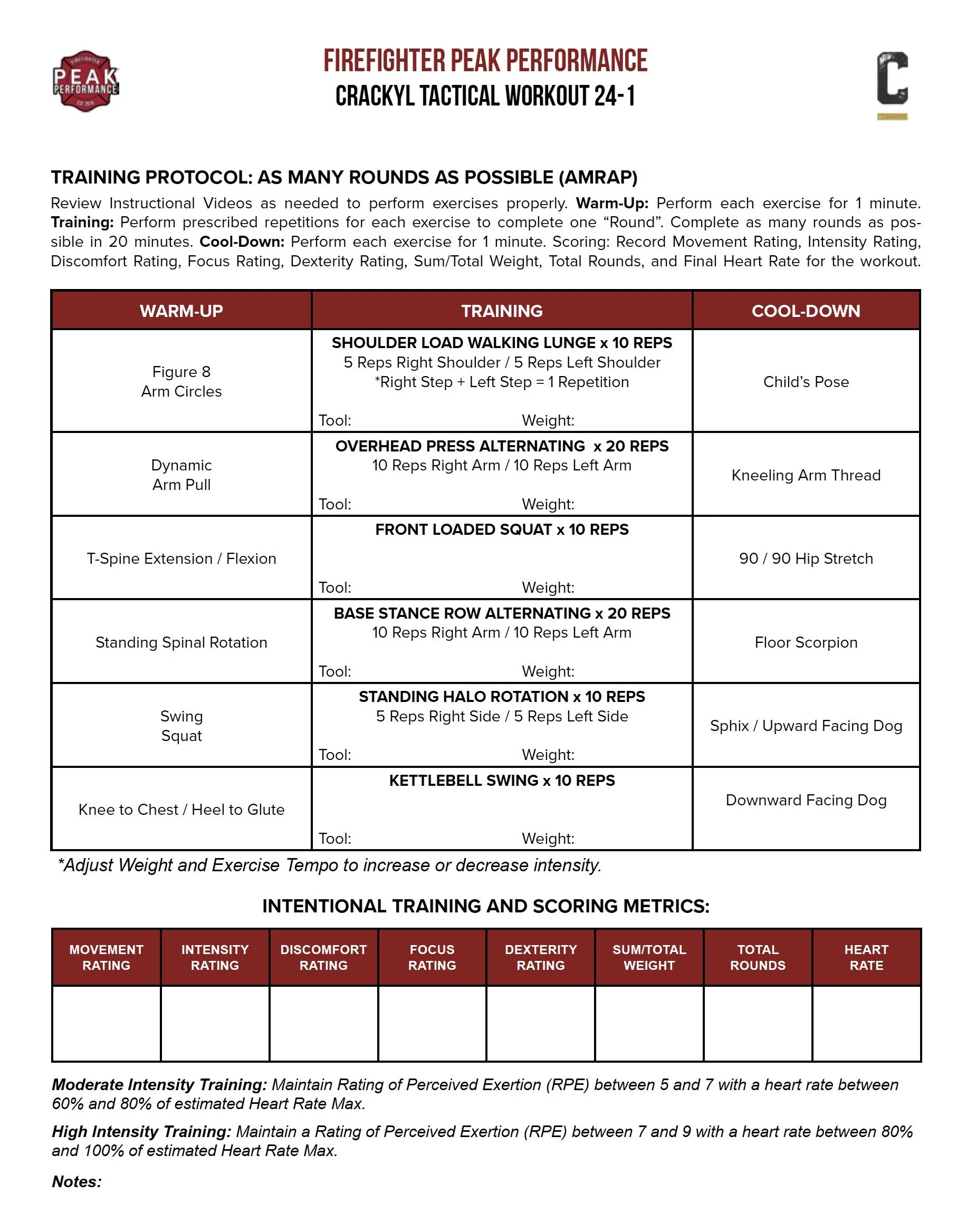
CRACKYL Workout 24-1 AMRAP uses sandbags and kettlebells to build firefighter strength, power, and sustained work capacity that carries over to the fireground.
This workout stands on its own as a complete session, with a focused warm-up, purposeful training, and comprehensive cool-down.
You can use it as a Workout of the Day, plug it into your current plan, or combine it with other sessions from the Firefighter Workouts Playlist to build a progressive tactical fitness program.
There is real value in a well-designed single workout. But firefighters benefit most from structured training that progresses over time.
One workout challenges you today. A progressive program builds strength, resilience, and durability across months and years.
That’s the difference between working hard in the gym and sustaining performance on the fireground.
If you’d like guidance on applying this workout within a progressive strategy, reach out anytime at ryan@firefighterpeakperformance.com.