
By Ryan Provencher, Founder of Firefighter Peak Performance and Executive Fitness Advisor for CRACKYL Magazine

Light-intensity training plays a critical role in firefighter performance and longevity. Learn how active recovery supports movement quality, operational readiness, and long-term resilience.
Firefighters are no strangers to hard work. Heavy training days, high-intensity calls, disrupted sleep, and cumulative stress place constant demands on the body.
The issue isn’t lack of effort—it’s adequate recovery.
Light-intensity training, often referred to as active recovery, plays a critical yet frequently overlooked role in firefighter performance and longevity. When used intentionally, it supports recovery between hard training sessions and demanding shifts, preserves movement quality, and prepares the body for higher-intensity work—without adding unnecessary training stress.
Active recovery is not about “doing nothing.” It’s about applying the right dose of movement to restore circulation, reduce stiffness, and maintain readiness. Used consistently, this approach supports long-term progress while helping firefighters stay response-ready when it matters most.
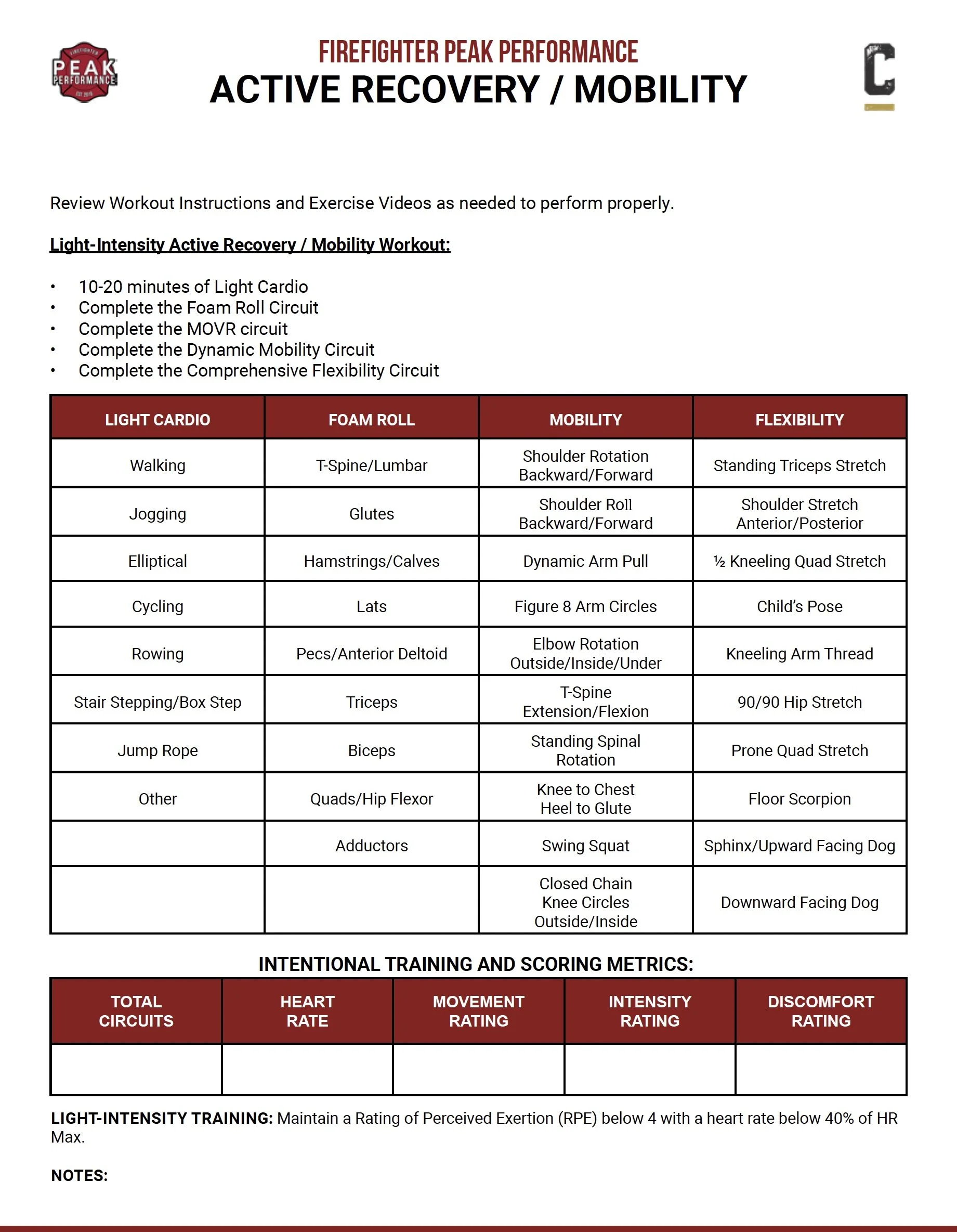
The Active Recovery Training Session below is a flexible, low-stress option for on-shift training, recovery between higher-intensity days, or managing accumulated fatigue as needed.
Light Activity: 10-20 Minutes
Light activity forms the foundation of active recovery. Light-intensity movement increases blood flow, delivers oxygen and nutrients to working tissues, and helps clear metabolic byproducts from prior training or work stress.
This portion of the session should feel easy and sustainable. Walking, cycling, rowing, light jogging, or similar modalities are all appropriate.
The goal is not conditioning—it’s restoration and readiness.
For firefighters, light activity reduces stiffness in the hips, low back, and shoulders after hard training, long shifts, or prolonged sitting—without adding nervous system stress.
Soft-Tissue Work: Foam Rolling
Soft-tissue work using a foam roller or similar tool helps reduce localized tension and restore movement quality. While it does not correct mobility limitations on its own, it prepares the body for more effective movement and recovery.
This tool is most effective for high-stress areas that commonly hold tension—calves, quads, glutes, low back, thoracic spine, and shoulders—regions repeatedly loaded by gear, tools, and repetitive movement.
Move slowly with steady, controlled breathing, staying just below the threshold of discomfort.
Dynamic Mobility Circuit
Dynamic mobility bridges the gap between recovery and readiness. It restores usable range of motion while reinforcing alignment, muscle activation, and movement control.
Each movement is performed in two 30-second intervals:
First 30 seconds: Move slowly and deliberately at the edges of your available range of motion. Pay attention to stiffness, asymmetry, or restriction.
Second 30 seconds: Increase tempo slightly while maintaining control and movement quality.
This approach allows firefighters to explore range safely before layering in speed, helping preserve joint health and reduce compensatory movement under load.
Comprehensive Flexibility Circuit
Comprehensive flexibility work closes the session by restoring resting muscle length and promoting relaxation. Unlike aggressive stretching, this method emphasizes controlled breathing and gradual release.
Each position is performed in two 30-second intervals:
First 30 seconds: Actively contract the target area during a five-second inhale, then relax on a five-second exhale.
Second 30 seconds: Focus entirely on relaxation. Stay just below discomfort and allow the tissues to release deeper into end range with each exhale.
This process reduces residual tension, calms the nervous system, and reinforces recovery—especially after hard workouts, stressful calls, or long shifts.
Active Recovery Training Session Instructions
This session is designed to be flexible and easy to implement on or off shift. It may be paused and resumed at any time if operational demands interrupt training on duty.
1. Light Activity
Complete 10–20 minutes at a conversational pace. Stay below ~40% max heart rate or ≤ 4 on the RPE scale.
2. Foam Roll Circuit
Complete the prescribed soft-tissue work for each muscle group using moderate pressure and controlled breathing.
3. Dynamic Mobility Circuit
Perform each movement for 1 minute (two 30-second intervals), progressing from slow and controlled to higher tempo and more dynamic.
4. Comprehensive Flexibility Circuit (Cool-Down)
Perform each stretch for 1 minute (two 30-second intervals), using contract–relax breathing followed by full relaxation.
Training Focus:
This light training session should leave you feeling loose and ready for your next higher-intensity challenge.
Workout TIMER
Use this Workout Timer for the Dynamic Mobility and Comprehensive Flexibility Circuits.
Scoring the Workout
Scoring light-intensity training reinforces awareness and consistency without adding intensity. Record the following:
Total Circuits Completed
Heart Rate
Movement Quality Rating
Intensity Rating
Discomfort or Stiffness Rating
Workout Score Sheet
Additional Resources
For step-by-step instruction, exercise demonstration, built-in timers, and additional firefighter-specific workouts, access your Firefighter Workouts Playlist and select the Active Recovery Workout.