
Firefighter Tactical Fitness Assessment: Measure Performance. Track Your Progress.
By Ryan Provencher, Founder of Firefighter Peak Performance and Executive Fitness Advisor for CRACKYL Magazine
The Firefighter Tactical Fitness Assessment measures firefighter-specific work capacity using firefighter movement patterns, scalable loading, and a “For Time” protocol designed around the work period of one SCBA air bottle.
Firefighter fitness can be difficult to evaluate in a way that meaningfully reflects the physical demands of the job.
There are several ways to approach the challenge, and each provides different information.
General fitness assessments evaluate individual attributes such as cardiovascular capacity, strength, muscular endurance, power, mobility, and body composition. Examples include VO₂ max testing, strength assessments, push-ups, vertical jumps, and mobility screens. The IAFF/IAFC Wellness-Fitness Initiative (WFI), for example, provides a comprehensive approach to evaluating several of these attributes in firefighters.
These assessments can provide valuable baseline information, but comprehensive testing may require specialized equipment, standardized protocols, and qualified fitness or clinical professionals to administer and interpret the results appropriately.
At the other end of the spectrum are job-specific assessments that evaluate performance through actual or simulated firefighting tasks. The Candidate Physical Ability Test (CPAT), department-specific physical ability tests, and fireground evolutions may incorporate stair climbing, hose deployment, forcible entry, equipment carries, ladder work, and victim rescue.
These assessments move closer to the actual work of firefighting, but they may require specialized facilities, props, PPE, equipment, staffing, and standardized administration. Some are also designed for a specific purpose, such as candidate selection, rather than ongoing fitness evaluation.
Both approaches have value, but there is considerable space between measuring individual fitness attributes and performing a full job-specific evaluation.
That space is where tactical fitness assessment can be useful.
Firefighting rarely asks us to demonstrate one physical quality or movement in isolation. On the fireground, firefighters must repeatedly produce and sustain force while transitioning between different positions, movement patterns, and tasks. Hose deployment may be followed by forcible entry, stair climbing, fire attack, search, and overhaul—all while managing fatigue and adapting to changing conditions.
Physical preparation for these demands requires strength, endurance, power, mobility, and movement quality, but it also requires the ability to integrate those qualities and apply them efficiently over time.
This is the purpose of the Firefighter Tactical Fitness Assessment (FTFA).
I developed the FTFA as a practical method for establishing a baseline of firefighter-specific work capacity and tracking progress over time. Rather than isolating individual fitness attributes or attempting to recreate emergency operations in the gym, the assessment combines foundational firefighter movement patterns, scalable resistance, and sustained physical work within a controlled training environment.
The FTFA consists of six exercises completed using a “For Time” training protocol, with a target duration of approximately 20 minutes—similar to the sustained work period of one SCBA air bottle. Repetitions, Exercise Level, and tempo can be adjusted according to current fitness, readiness, and the intended intensity of the session, allowing the assessment to be performed with relatively simple equipment in a fire station, home, or conventional gym.
The FTFA is not a clinical fitness evaluation, a validated occupational standard, or a substitute for job-specific physical ability testing. Its purpose is to bridge the gap between general fitness and job-specific performance by providing a controlled and repeatable way to assess firefighter-specific work capacity.
Completion time is only part of the assessment. The FTFA combines objective performance metrics with subjective measures of movement quality, intensity, discomfort, focus, and dexterity to provide greater context for evaluating performance over time.
Ultimately, the assessment is designed to answer a practical question:
Is your training improving the physical capacity you need to meet the demands of the job?
What the FTFA Measures
Work capacity is central to the FTFA, but performance depends on the integration of several physical qualities.
The six exercises require different combinations of strength, muscular endurance, power, cardiovascular conditioning, coordination, stability, and movement quality. Performed sequentially, they also challenge the ability to apply these qualities as fatigue develops.
Strength and muscular endurance contribute to the ability to repeatedly move external resistance and maintain force production across higher repetition ranges.
Power contributes to explosive movements such as the Med Ball Lateral Throw and Med Ball Press + Pullover Slam.
Movement quality reflects the ability to maintain sound mechanics and control as workload and fatigue increase.
Cardiovascular response provides additional information about the physiological demand required to complete the prescribed work.
The FTFA also incorporates focus and dexterity ratings to increase awareness of how fatigue may affect concentration and basic fine-motor control.
Together, these qualities contribute to the firefighter-specific work capacity the FTFA is designed to assess.
Training Protocol: For Time
The FTFA uses a “For Time” training protocol in which the firefighter completes a selected workload and records the time required to finish it.
The goal is to select a workload that can be completed in approximately 20 minutes, creating a sustained work period similar in duration to operating on one SCBA air bottle. The 20-minute target is not intended to reproduce the physiological or environmental demands of interior firefighting. Instead, it provides an operationally relevant time frame for evaluating the ability to sustain physical work across multiple movement patterns.
Because the workload and completion time are recorded, performance can be compared across sessions and tracked over time.
However, faster is not automatically better.
Movement quality should remain at 8 out of 10 or higher throughout the assessment. If technique begins to deteriorate, adjust your workload or pace before sacrificing movement quality to finish faster.
The objective is not simply to become faster at the FTFA. It is to become more capable of completing challenging physical work efficiently and with control.
Training Exercises
The FTFA uses six exercises that apply foundational movement patterns to develop physical qualities that support common firefighting tasks.
Sandbag Walking Lunge
Movement Pattern: Lunge
Firefighting Applications: Advancing Hose, Climbing Stairs
The Sandbag Walking Lunge develops unilateral lower-body strength and endurance while the offset shoulder load challenges coordination and trunk stability. These qualities support moving efficiently under load during hose deployment, stair climbing, and equipment carries.
Repetitions should be divided evenly between the right and left shoulders.
Right step + left step = one repetition.
P-Bar 4-Point Press
Movement Pattern: Horizontal Push
Firefighting Applications: Interior Search, Ground-Based Movement
The P-Bar 4-Point Press develops upper-body strength and endurance, shoulder stability, trunk control, and coordinated movement close to the ground. These qualities support the physical demands of primary and secondary search and other tasks performed from low or compromised positions.
The movement may also be performed on the floor when P-Bars are unavailable.
Med Ball Lateral Throw
Movement Pattern: Rotation
Firefighting Applications: Forcible Entry, Vehicle Extrication
The Med Ball Lateral Throw develops explosive rotational power and coordinated force transfer through the lower body, hips, and trunk. These qualities support tasks that require force to be generated and transferred through rotational movement.
Repetitions should be divided evenly between the right and left sides.
Sandbag Front-Loaded Squat
Movement Pattern: Squat
Firefighting Applications: Moving Equipment, Moving Patients
The Sandbag Front-Loaded Squat develops lower-body strength and muscular endurance while challenging trunk stability under an anterior load. These qualities support lifting, repositioning, and carrying equipment, patients, and other external loads.
Kettlebell Split-Stance Row
Movement Pattern: Horizontal Pull
Firefighting Applications: Pulling Hose, Hoisting Equipment
The Kettlebell Split-Stance Row develops pulling strength, grip endurance, trunk stability, and anti-rotation control. The split stance also challenges the ability to produce force while maintaining a stable position.
Repetitions should be divided evenly between the right and left arms.
Med Ball Press + Pullover Slam
Movement Pattern: Vertical Push + Pull
Firefighting Applications: Breaching Ceiling, Pulling Ceiling
The Med Ball Press + Pullover Slam combines vertical pushing and pulling within one continuous movement. The upward phase develops overhead force production, while the pullover and slam develop force through the vertical pulling pattern. These qualities support overhead work involved in breaching and overhaul.
Together, these six exercises apply multiple foundational movement patterns within one sustained training protocol, requiring the firefighter to repeatedly produce and control force as fatigue develops.
The challenge, however, needs to match the firefighter performing it. That is where scaling becomes important.
Scaling and Progressing the FTFA
The FTFA does not require every firefighter to begin with the same workload or resistance.
Instead, repetitions, Exercise Level, and tempo can be adjusted to match current fitness, readiness, and the intended intensity of the session. The work performed is recorded so performance remains measurable even as the assessment is scaled.
The FTFA can be performed at either moderate or high intensity depending on its placement within your training program. Moderate-intensity sessions emphasize controlled, sustainable effort, while high-intensity sessions challenge you to sustain a greater level of effort. In both cases, the goal is to select a workload that allows you to maintain excellent movement quality throughout the assessment.
As a general guide:
Moderate Intensity
RPE: 5–7 out of 10
Heart Rate Guide: Approximately 60–80% of estimated maximum
Goal: Maintain a challenging but controlled effort with consistent pacing and movement quality.
High Intensity
RPE: 7–9 out of 10
Heart Rate Guide: Approximately 80–95% of estimated maximum
Goal: Sustain a higher level of effort while continuing to maintain movement quality and control.
The difference between moderate and high intensity is determined by the overall training demand, not any single variable. Repetitions, Exercise Level, and tempo can be adjusted independently or together to achieve the intended intensity. Neither should require you to sacrifice movement quality simply to complete more work or finish faster.
Repetitions
Select the number of repetitions based on your current fitness, readiness, and intended training intensity.
The recommended range is 24–50 repetitions per exercise, although lower repetitions may be appropriate when first learning the assessment or returning to training after a break.
Record the repetitions completed for each exercise so the workload can be accurately compared over time.
Exercise Level
Each exercise includes three challenge levels that provide a consistent framework for scaling and progression.
For loaded exercises:
Level 1: Up to 25 pounds
Level 2: 26–50 pounds
Level 3: Over 50 pounds
For the P-Bar 4-Point Press, progression is based on movement complexity rather than external resistance:
Level 1: 4-Point Press
Level 2: Forward Ellipse
Level 3: Reverse Ellipse
Select an Exercise Level that provides an appropriate challenge while allowing excellent movement quality to be maintained throughout the assessment.
Tempo
Tempo provides a simple way to regulate intensity in real time. Move efficiently when movement quality is high, and adjust your pace as needed to achieve the intended intensity while maintaining control.
Time
Approximately 20 minutes is the target for both moderate- and high-intensity sessions.
If the selected workload consistently requires more than approximately 25 minutes, consider reducing repetitions or Exercise Level. If it is completed comfortably in less than 20 minutes with excellent movement quality, consider increasing repetitions or progressing Exercise Level.
Together, these variables allow the FTFA to meet you where you are while providing clear progression opportunities.
How to Perform the FTFA
Before beginning, review instructional videos for unfamiliar movements and select the appropriate repetitions and Exercise Level for each exercise based on your current fitness and the prescribed intensity of the session.
Complete the Dynamic Warm-Up before beginning the assessment.
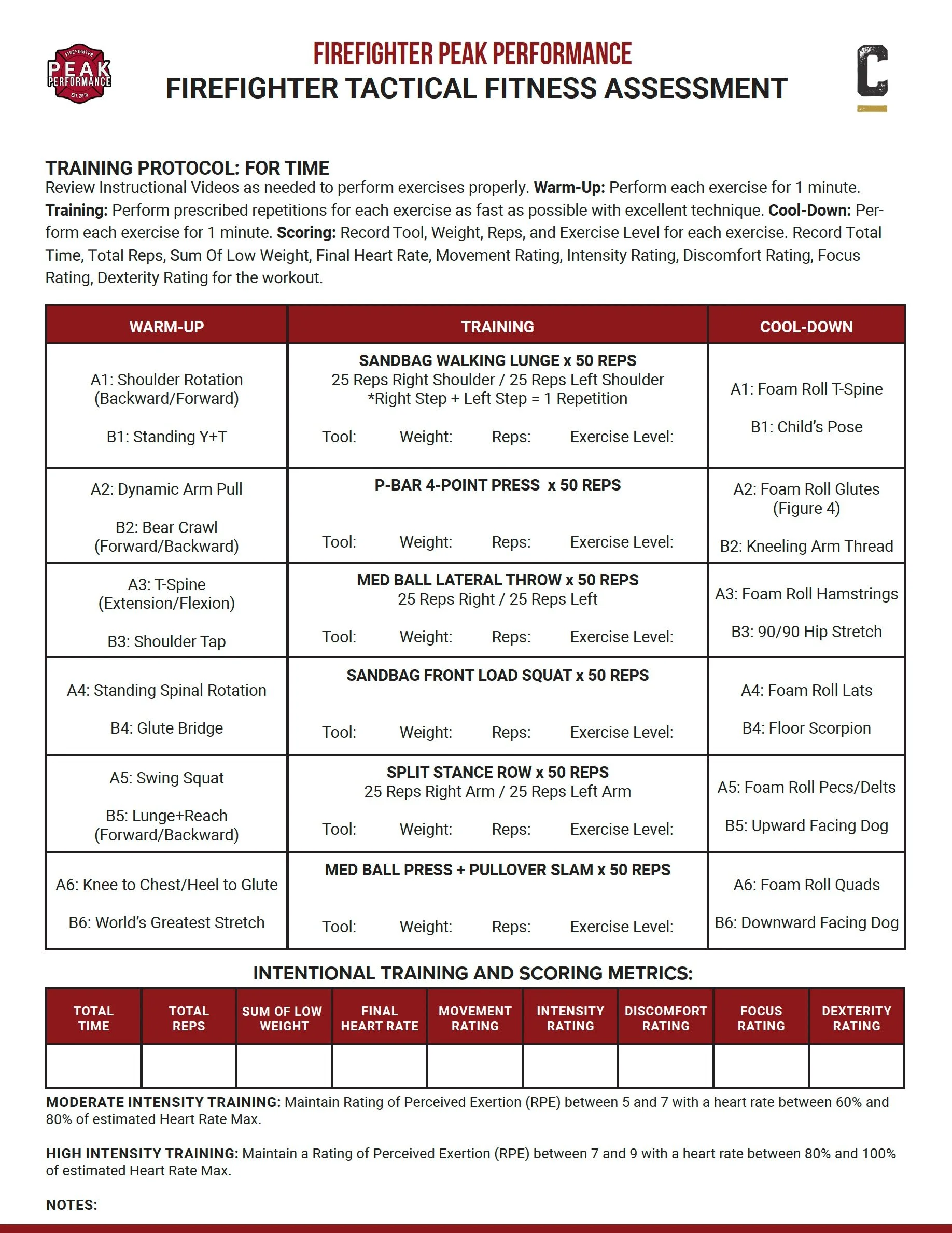
Then perform the selected repetitions of each exercise For Time, completing each movement before progressing to the next:
Sandbag Walking Lunge
P-Bar 4-Point Press
Med Ball Lateral Throw
Sandbag Front-Loaded Squat
Kettlebell Split-Stance Row
Med Ball Press + Pullover Slam
Move as efficiently as possible while maintaining excellent movement quality. Record the repetitions, resistance, and Exercise Level used for each exercise along with your total completion time.
After completing the assessment, perform the Comprehensive Cool-Down to begin the recovery process.
Primary equipment includes sandbags, P-Bars, medicine balls, and kettlebells. Alternatives such as hose bundles, steel clubs, dumbbells, exercise bands, and bodyweight variations may be used when necessary, provided the intended movement pattern and training objective are maintained.
If this is your first time performing the FTFA, approach the session as an opportunity to learn the movements, determine the appropriate workload, and establish a baseline rather than immediately chasing your fastest possible time.
FTFA TIMER
Scoring the Assessment
Scoring the workout is part of the workout.
The purpose is not competition. Scoring establishes a baseline, provides context for performance, and generates information that can guide future training.
Record the tool, weight, repetitions, and Exercise Level used for each exercise. These details provide important context when comparing performance across future sessions.
Performance is evaluated using both objective and subjective metrics.
Objective Performance Metrics
Total Time records how long it takes to complete the selected workload.
Total Repetitions documents how much work was completed and allows performance to remain measurable when volume changes.
Load and Exercise Level provide context for the difficulty of the work performed. A faster time at a lower Exercise Level does not necessarily represent improvement over a slightly slower time at a substantially higher level.
Final Heart Rate provides an additional indicator of the physiological demand associated with completing the assessment.
Subjective Performance Metrics
Objective data describes what you accomplished. Subjective feedback provides additional context for how you performed while accomplishing it.
Movement Rating evaluates exercise technique and movement quality. Maintain at least 8 out of 10 throughout the assessment.
Intensity Rating uses a 1–10 Rating of Perceived Exertion scale to describe how hard you were working.
Discomfort Rating identifies pain or discomfort that may require you to modify or stop an exercise.
Focus Rating evaluates your ability to remain mentally engaged and accurately manage the workout.
Dexterity Rating considers basic fine-motor control as fatigue accumulates.
Completion time should never be considered in isolation. A faster time does not necessarily represent better performance if it requires poorer movement quality, significantly greater discomfort, or loss of control.
FTFA Score Sheet
Measuring Progress Over Time
The greatest value of the FTFA comes from tracking performance over time.
Your first assessment establishes a baseline. From there, progress can take several forms.
Progress may mean completing the same workload in less time, completing more work within a similar time frame, or advancing to a higher Exercise Level while maintaining comparable time and movement quality. It may also mean completing a similar workload with a lower heart rate, lower perceived intensity, or better movement quality and control.
Because workload can change between sessions, completion time must be considered in the context of the work performed.
Consider the relationship between repetitions, Exercise Level, time, physiological response, and movement quality when evaluating progress.
When you want a more direct comparison with a previous performance, repeat the assessment under reasonably similar conditions.
The goal is to identify a trend toward increased physical capacity and improved performance over time.
Using the Assessment to Guide Training
An assessment only becomes useful when the information influences what you do next.
In the fire service, a good Size-Up helps us determine our Strategy before applying tactics and tasks. Physical training can follow the same process.
The FTFA provides one component of your fitness Size-Up by establishing a baseline of firefighter-specific work capacity. Your results can then help guide the training strategy that follows.
If movement quality deteriorates early, movement proficiency, Exercise Level, or pacing may deserve greater attention. If movement remains strong but your work rate declines substantially, conditioning and sustained work capacity may be limiting factors.
If you can perform more work, progress to a higher Exercise Level, or complete a comparable workload with a lower physiological or perceived cost, your training is likely producing meaningful adaptation.
After a period of structured training, repeat the assessment and compare the results.
This creates a simple performance feedback loop:
Assess → Train → Reassess → Adjust
The assessment does not make every training decision for you. It provides better information with which to make those decisions.
From Gym Performance to Fireground Performance
The value of the FTFA is not found in a single finishing time. It is found in what that performance tells you about your physical preparation and how you use that information moving forward.
Ultimately, the goal is not to become better at taking the FTFA. The goal is to develop the physical capacity that better prepares you for the demands of the job.
Measure your performance. Track your progress.
Train With Purpose. Perform With Confidence. Be Response Ready.