
Simple Tools Series: Kettlebell 20/10 Interval Workout
By Ryan Provencher, Founder of Firefighter Peak Performance and Executive Fitness Advisor for CRACKYL Magazine
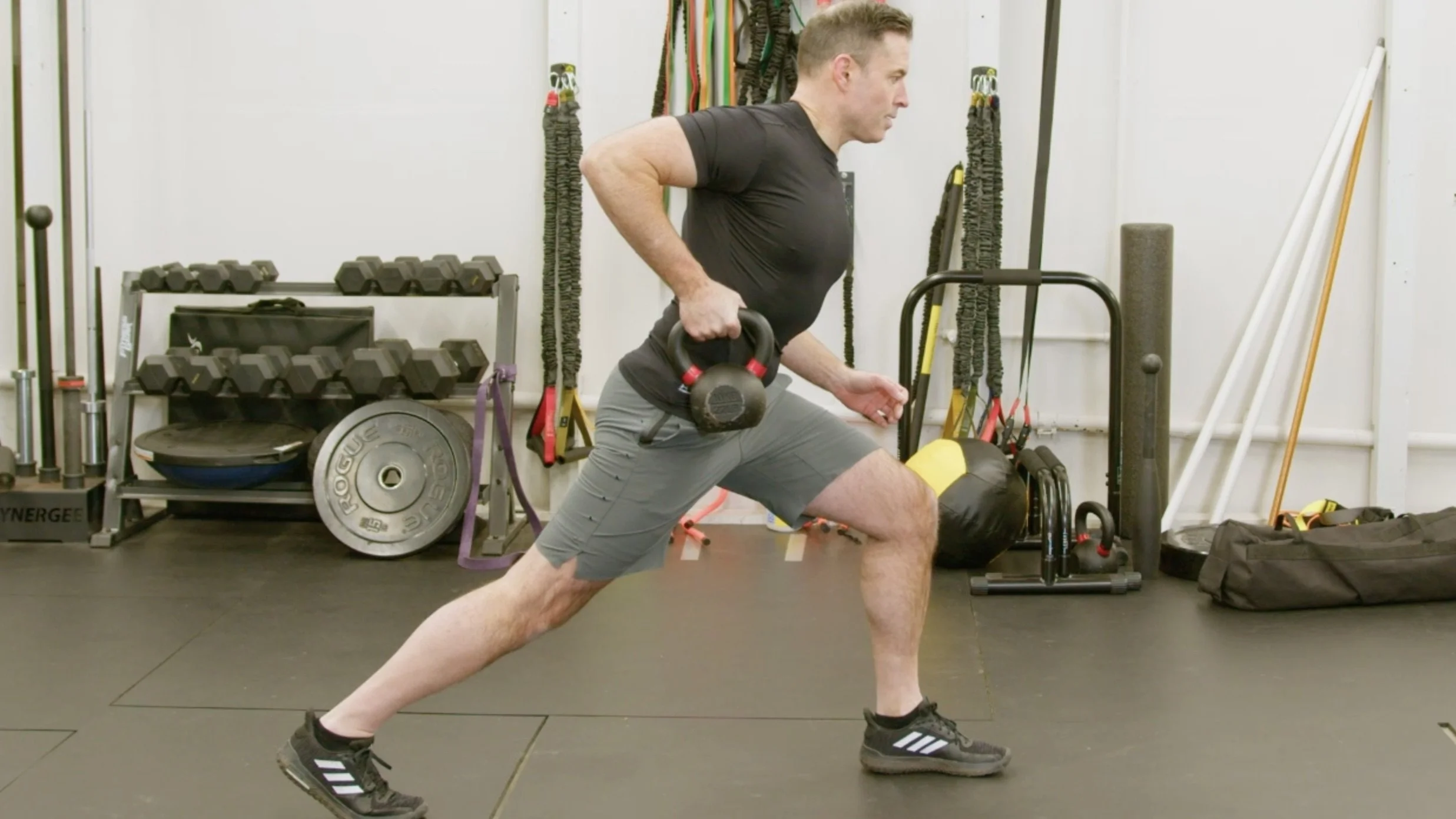
This firefighter-specific kettlebell workout uses a 20/10 interval protocol to develop explosive power, strength endurance, and repeatable work capacity.
Firefighter tactical fitness does not require complex equipment or elaborate facilities. It requires intentional training—grounded in sound movement, appropriate workload, and energy system demands that reflect the realities of the job.
The Simple Tools Series is a collaboration between Firefighter Peak Performance and CRACKYL Magazine, highlighting practical, field-tested training tools that support firefighter readiness through specific, comprehensive physical training.
These tools are versatile, affordable, and accessible, making them ideal for use in the station, the recruit academy, or a home gym.
At its core, this series is about helping firefighters train with purpose—not just to work hard, but to train in a way that carries over to the fireground.
This workout centers on one of the most effective and versatile tools in firefighter training: The Kettlebell.
TOOL: KETTLEBELL
Kettlebells rank among the most effective, efficient, and versatile training tools available, delivering benefits that traditional gym equipment often cannot match.
Unlike many machine-based exercises, kettlebell training develops strength through various positions that require coordination, balance, stability, and force transfer across the entire body. Firefighters rarely operate from seated or supported positions commonly found in commercial gyms. They lift, carry, climb, pull, push, and move while managing awkward loads and changing environments.
The kettlebell allows you to train those qualities directly.
Its offset center of mass challenges the body to stabilize while producing force, developing strength, trunk stability, grip endurance, and coordination simultaneously.
This has direct carryover to tasks such as:
Advancing hose lines
Deploying and raising ladders
Carrying equipment
Operating power tools
Lifting and moving patients
Kettlebell training bridges the gap between traditional strength training and occupational performance, enabling firefighters to build strength that directly transfers to the demands of the fireground.
TRAINING PROTOCOL: 20/10 INTERVALS
This workout employs a 20/10 interval training protocol, consisting of 20 seconds of work followed by 10 seconds of recovery.
Each exercise is performed for eight consecutive work intervals before moving to the next movement.
This structure challenges firefighters to produce force repeatedly while managing fatigue and maintaining movement quality throughout the training session.
When programmed and executed with intent, this protocol develops:
Anaerobic power
Muscular endurance
Work capacity
Recovery efficiency
Coordination under fatigue
The short work periods encourage explosive movement while the limited recovery intervals challenge the body's ability to recover and perform again.
Fireground operations often require repeated bouts of physical effort—lifting equipment, deploying ladders, pulling hose, forcing entry, and operating tools—followed by brief opportunities to recover before the next task begins.
The ability to produce force repeatedly while maintaining control is critical.
This format is built to reinforce that cycle:
Work. Recover. Repeat.
This is not random intensity.
It is structured, repeatable effort that builds capacity over time.
MANAGING INTENSITY
One of the most valuable aspects of the 20/10 protocol is the ability to adjust intensity in real time based on movement quality and response to the workload.
Firefighters are not training for a single effort.
We are training for sustained performance across an entire incident—and across a career.
Intensity must be selected with intent.
Volume
The number of repetitions you strive for in each interval should reflect your current fitness level and the prescribed training goal (moderate vs. high intensity). The goal is consistent output across all intervals—not a dramatic drop-off after the first few rounds.
Load
Load can be adjusted by selecting an appropriate kettlebell weight:
Level 1: Up to 25 lb
Level 2: 26–50 lb
Level 3: Over 50 lb
Choose a load that allows you to move explosively while maintaining control and proper mechanics.
Tempo
Tempo is the primary driver of intensity in this workout.
Move with intent and speed—but never at the expense of position or control. Maintain a movement quality rating of 8 out of 10 or higher throughout the workout.
If technique begins to break down, reduce speed before sacrificing movement quality.
As a general guideline:
Moderate Intensity Training:
RPE 5–7, heart rate 60–80% of estimated maximum
High Intensity Training:
RPE 7–9, heart rate 80–95% of estimated maximum
The goal is not to empty the tank in one interval.
The goal is to sustain high-quality output over the entire training session.
WORKOUT TIMER
TRAINING EXERCISES
Each movement in this workout reinforces essential movement patterns, develops specific physical qualities, and supports real-world firefighting tasks.
Front Rack Split Squat
Utilizes the Lunge movement pattern to develop lower-body strength, unilateral stability, trunk engagement, and force production. This movement supports tasks such as stair climbing, advancing hose lines, working on uneven terrain, and maintaining stability while carrying equipment on one side.
One-Arm Overhead Press
Utilizes the Vertical Push movement pattern to develop shoulder stability, upper-body strength, trunk control, and force transfer throughout the kinetic chain. This movement supports tasks such as deploying ladders, lifting equipment overhead, operating tools, breaching ceiling, and applying force in overhead positions.
FRONT-LOADED Squat
Utilizes the Squat movement pattern to develop lower-body strength, trunk stability, coordination, and force production. This movement supports tasks such as lifting equipment, moving patients, carrying heavy loads, and repeatedly transitioning between standing and working positions.
Split Stance Row
Utilizes the Horizontal Pull movement pattern to develop upper-back strength, grip endurance, trunk stability, and pulling power. This movement supports tasks such as pulling hose lines, operating tools, victim drags, and maintaining control of equipment under challenging conditions.
WORKOUT INSTRUCTIONS
Warm-Up
Perform each dynamic movement for one minute, focusing on range of motion, control, and movement quality.
Training
Perform each exercise for 20 seconds, followed by 10 seconds of recovery. Complete eight consecutive intervals for each exercise before moving to the next movement.
Alternate between the right and left sides during unilateral exercises. Odd-numbered intervals are performed on the right side and even-numbered intervals are performed on the left side.
Recover for one minute between exercises.
Cool-Down
Perform each recovery movement for one minute, emphasizing breathing, mobility, and recovery.
Find full exercise demos and coaching instructions for each movement in the Firefighter Workouts Playlist.
SCORING THE WORKOUT
Fitness without feedback is guesswork.
Scoring the workout is part of the workout.
This is not about competition for competition’s sake—it is a tool for accountability, awareness, and progress.
On the score sheet provided in your Kettlebell Workout PDF, you will track:
Sum of Low Repetitions
Sum of Low Weight
Heart Rate
Movement Rating
Intensity Rating
Discomfort Rating
Focus Rating
Dexterity Rating
Objective metrics show what you did.
Subjective metrics reveal how your body and mind responded to the workload.
Together, they provide a complete picture of performance—not just fitness in the gym, but readiness for the fireground.
Strength, endurance, and work capacity matter. So does self-awareness. Monitoring factors such as movement quality, discomfort, focus, and perceived exertion helps firefighters better understand their response to training, manage fatigue, and make informed decisions about performance and recovery.
WORKOUT SCORE SHEET
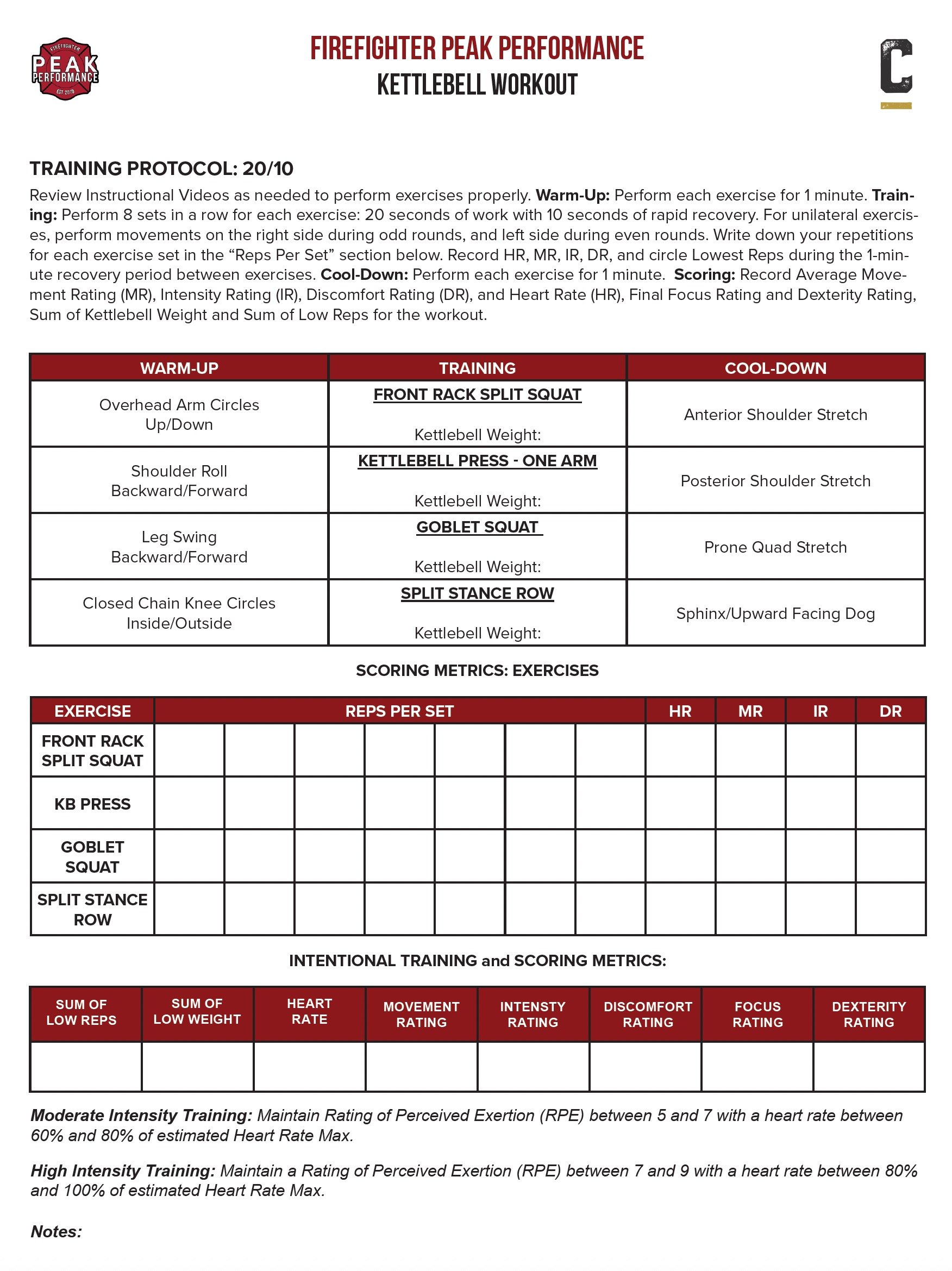
Go to your Firefighter Workouts Playlist to download, save, and print the PDF.
The Kettlebell 20/10 Interval Workout is designed to develop explosive power, strength endurance, and repeatable work capacity—qualities that matter when you're assigned demanding tasks in emergency response.
You can use it as a Workout of the Day, plug it into your current plan, or combine it with other sessions from the Firefighter Workouts Playlist to build a progressive tactical fitness program.
There is real value in a well-designed single workout. But firefighters benefit most from structured training that progresses over time.
One workout challenges you today. A progressive program builds strength, resilience, and durability over months and years.
That's the difference between leaving the gym exhausted—and showing up on scene prepared.